
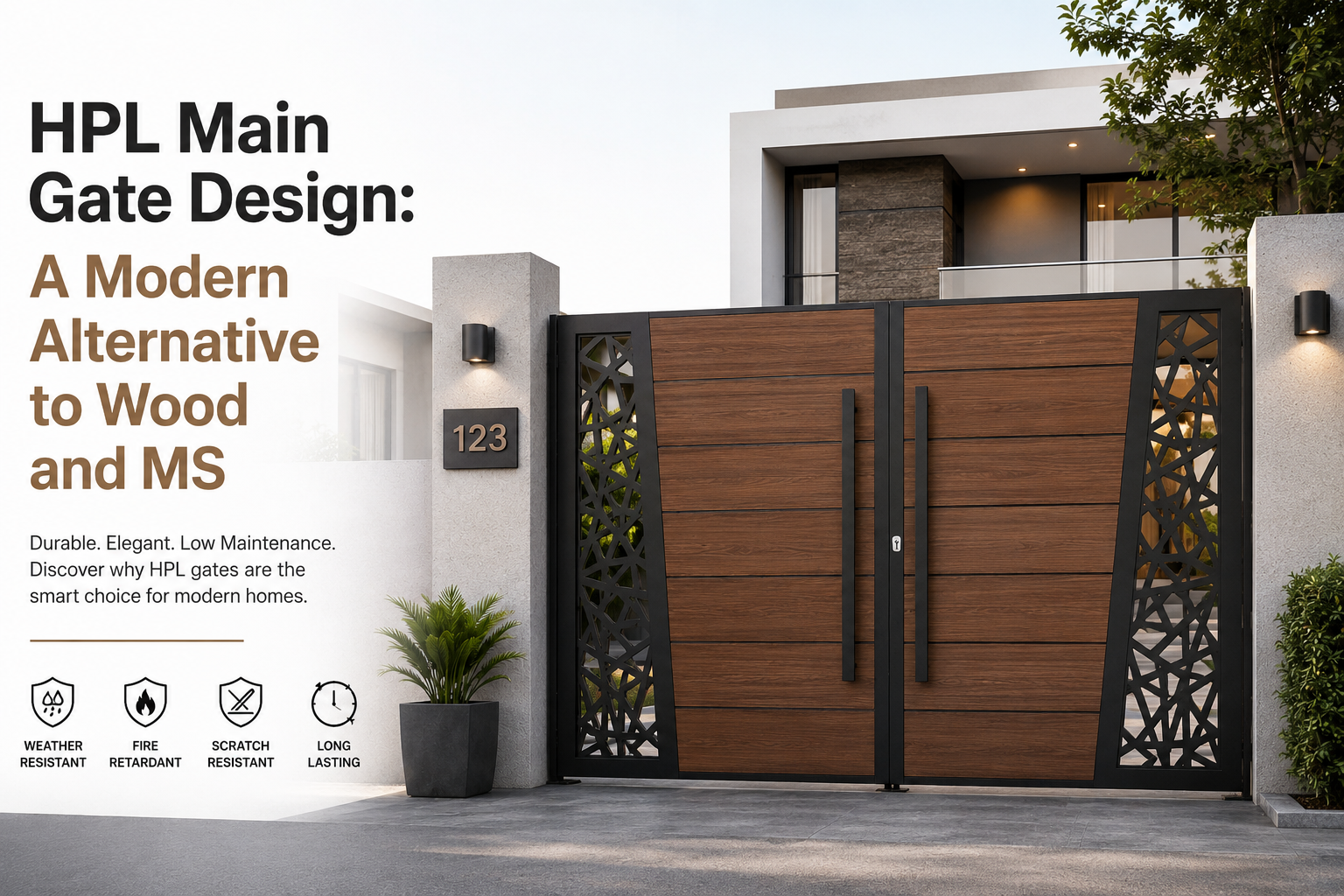
Quick answer: An HPL main gate is a steel or aluminium frame clad with exterior-grade HPL panels, usually 6mm or 8mm. It gives the look of solid timber without warping, termites, repainting or rot, and it holds colour under direct sun far longer than painted mild steel.
Table of Contents
- Why Traditional Gate Materials Struggle in India
- How an HPL Gate Is Built
- Design Directions
- Practical Considerations Before You Order
- Maintenance and Life
- Frequently Asked Questions
Why Traditional Gate Materials Struggle in India
| Material | Typical problem | Maintenance cycle |
|---|---|---|
| Solid timber | Warps, swells in monsoon, termite risk, splits in dry heat | Polish or repaint every 1-2 years |
| Painted mild steel | Rusts at welds and base, chalks in UV | Repaint every 2-3 years |
| WPC and PVC panels | Sags in heat over long spans, colour fades | Replace sections periodically |
| Exterior HPL on steel frame | Needs a properly designed frame | Wash occasionally |
The gate is the hardest-working exterior element on a plot. It sits in full sun, gets hit by rain from every angle, and is touched by hands, vehicles and delivery trolleys daily. Anything with a surface coating eventually loses that coating.
How an HPL Gate Is Built
- A structural frame is fabricated in MS box section or aluminium, sized for the leaf width and the gate mechanism.
- The frame is treated and finished – galvanised or powder coated – because it will never be accessible again once clad.
- Sub-members are added at the spacing required for the panel thickness, typically closer than a wall grid because gates flex when moved.
- Exterior HPL panels, usually 6mm or 8mm, are fixed with concealed or colour-matched fasteners.
- Edges are finished with an aluminium profile or a clean mitred detail.
- Hardware – rollers, motor, hinges – is sized for the final weight including panels.
That fourth point about weight matters. HPL is denser than the WPC or aluminium sheeting some fabricators expect, so the gate motor and roller assembly must be specified after the cladding decision, not before.
Design Directions
- Full wood-look leaf – a continuous teak or walnut finish across the whole gate, reading as solid timber from the street.
- Slat and gap – narrow HPL slats with deliberate gaps, giving privacy with airflow and a strong linear rhythm.
- Two-tone panel grid – a dark frame with warm wood infill panels, which suits contemporary Indian facades well.
- CNC jaali insert – a perforated HPL panel section for light, ventilation and a distinctly modern-traditional character.
- Matched compound wall – continuing the same shade along the boundary wall so the gate is part of a composition rather than an object.
- Integrated house number and lighting – CNC-cut numerals in a contrasting panel with concealed LED behind.
Practical Considerations Before You Order
- Wind load – a large solid gate leaf is a sail. Slatted designs relieve pressure and are the safer choice for wide openings.
- Thickness – use 6mm minimum, 8mm for large leaves or where the gate will take physical contact.
- Frame spacing – closer than a wall facade, because the panel is subjected to movement and vibration.
- Ground clearance – keep the bottom panel edge clear of standing water and splash.
- Fasteners – stainless or coated only; ordinary fasteners will bleed rust stains down the panel face.
- Automation – confirm motor capacity against the finished weight before ordering the mechanism.
Maintenance and Life
A well-built HPL gate needs washing with mild detergent and an occasional check of the frame fasteners and roller alignment. There is no polishing, no repainting, and no annual anti-termite treatment.
Because HPL Maker exterior sheets carry a live camera warranty of up to 25 years, a gate clad in the same material has a documented performance expectation rather than a hope.
Key Takeaways
- An HPL gate is exterior laminate on a treated steel or aluminium frame, usually 6mm or 8mm.
- It gives a timber look without warping, termites or repainting.
- Frame spacing must be tighter than a wall facade because gates flex when moved.
- Slatted designs reduce wind load on wide openings.
- Confirm motor and roller capacity after accounting for panel weight.
Frequently Asked Questions
Is HPL good for a main gate?
Yes. Exterior-grade HPL on a properly built steel frame resists sun, rain, termites and daily handling far better than timber or painted mild steel, and needs only occasional washing instead of annual polishing or repainting.
What thickness of HPL is used for gates?
6mm is the practical minimum and 8mm is preferred for large leaves or gates that will take physical contact. Frame sub-members should be spaced closer than on a wall facade because a gate moves and vibrates.
Will an HPL gate fade in the sun?
Exterior-grade HPL with UV-protective surfacing is designed to hold colour for many years under direct sun. Interior-grade laminate used on a gate will fade quickly, which is why the grade on the invoice matters.
Can HPL be used on an automatic sliding gate?
Yes, provided the motor, rollers and track are specified for the finished weight including the panels. HPL is denser than aluminium sheeting, so the hardware must be sized after the cladding decision.
How do I clean an HPL gate?
Rinse off dust, wash with mild pH-neutral detergent and a soft cloth, then rinse and wipe dry. Avoid abrasive pads and strong solvents, which permanently dull the surface.
Related Reading on HPL Maker
Talk to HPL Maker
HPL Maker is an Indian manufacturer of exterior-grade high pressure laminate with an industry-first live camera warranty of up to 25 years. Share your drawings or elevation photos and our team will suggest the right shade, thickness and fixing system for your project.
- Call / WhatsApp: +91 89824 90236
- Email: marketing@hplmaker.com
- Factory & Head Office: 124-126, Vrindavan Palace, Nipania Main Road, Vijay Nagar, Indore – 452010, Madhya Pradesh, India